

Canada has great science but struggles to turn it into economic value. Canada’s spending on higher-education R&D ranks above the G7 average, while its business R&D is among the lowest in the G7 and has been trending down for two decades. With its economic sovereignty threatened, Canada must even more urgently close the commercialization gap.
The Eddie Goldenberg Research Chairs of Canada help. Last week the government announced the first cohort of 64 Chairs, for a total expenditure of $504 million over eight years. It’s a great programme.
One of five selection criteria targets “Potential for knowledge translation, mobilization and application of research results,” which includes but is not limited to commercialization.
Assuming the best predictor of future commercialization is the track record of these new chairholders, I describe it here using publicly available information and AI assistance (Claude, Anthropic). My methods are detailed in the annexed note, and the xls file contains my findings so others may check them.
Commercializing science is not a uniquely Canadian challenge. Funders do publish commercialization numbers — the ERC found that 44% of its surveyed patent-holding grantees had commercially used their patents. But those are all ex post: what researchers did with the money. In searches of published literature across Europe, the UK, the US, Australia, Japan, Korea and the Nordics, I could find no analysis of what a newly announced cohort had already done before it was selected — the question that tests whether a selection criterion works.
This is a worked Canadian example. The methods and lessons of this analysis may be of use to other countries.
41% arrived with a track record of commercialization
Figure 1 shows the incidence of commercialization among the cohort. Twenty-six of the 64 (41%) had already commercialized their science, either by generating intellectual property, founding a company, or holding equity related to their research. Thirteen researchers had founded 29 companies, and 9 were serial entrepreneurs.
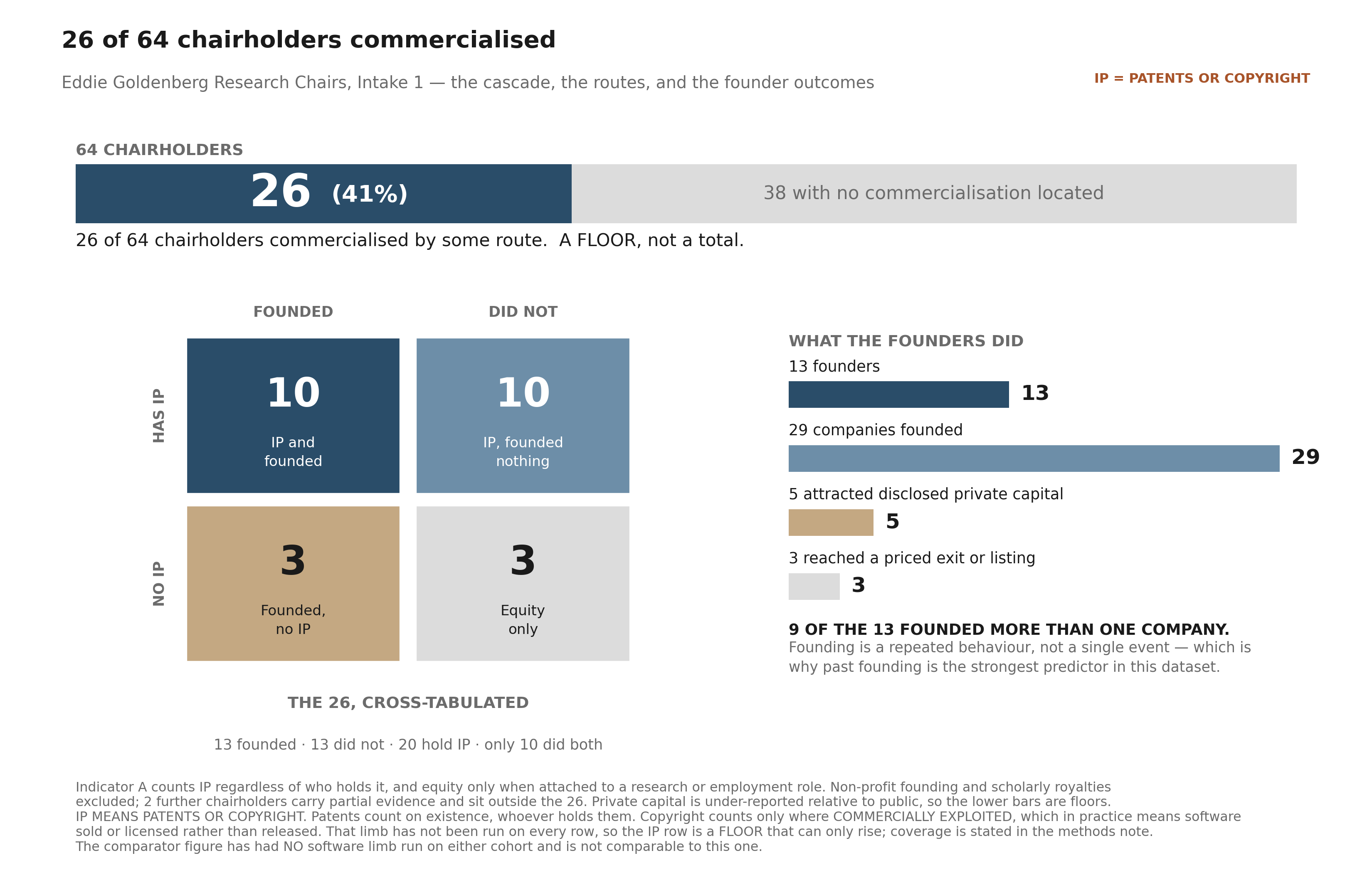
I used a deliberately inclusive definition of ‘commercialization.’ A patent counts on its existence — whoever holds it, and whether or not it was ever licensed — which accounts for seven of the 26. Research-linked equity counts even without IP or a company founded, which accounts for three more. On the strictest reading, requiring evidence of commercial exploitation, the figure would be 16 of 64, or 25%.
Figure 2 shows how little of the economic value is publicly visible. One of the researchers founded a US company twenty-four years ago, now worth more than US $30 billion. If he had done this in Canada, that would be among the biggest academic spin-offs ever. However, the main finding is that economic value is hard to describe from public information. Many companies are private, licensing agreements are confidential, and other routes to commercialization are even more difficult to value.
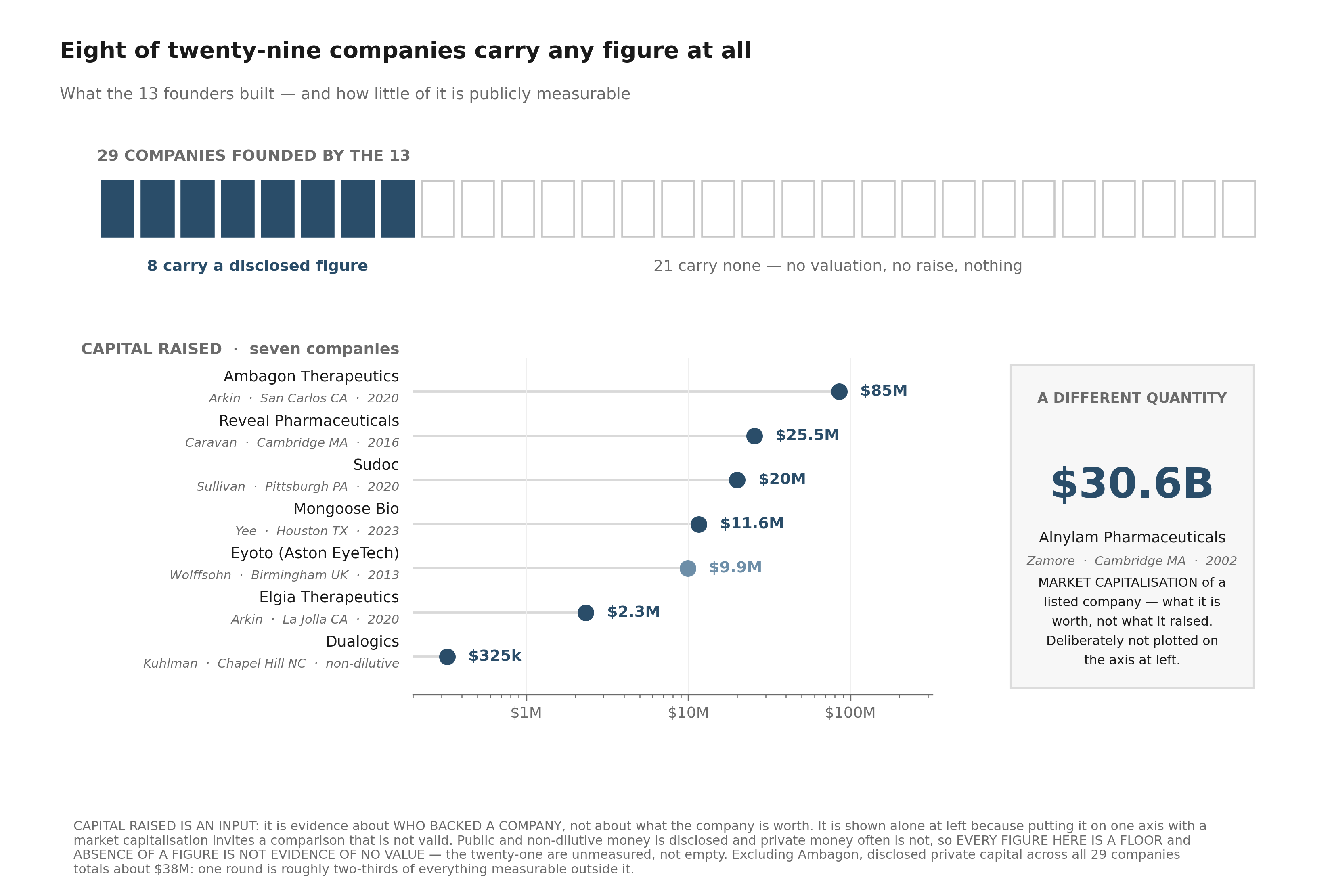
Figure 3 compares the commercialization track record of the Goldenberg Chairs to the most comparable existing programme, the Canada Excellence Research Chairs, which did not have a separate and equally weighted selection criterion for knowledge translation, mobilization, and application of research results. Goldenberg Chairs led on both measures by about fifteen percentage points, although neither difference reaches statistical significance at these sample sizes. (To compare fairly, I re-ran a deliberately shallow search — the same two queries per person — on both cohorts, which is why the Goldenberg rate here is lower than in Figure 1.)
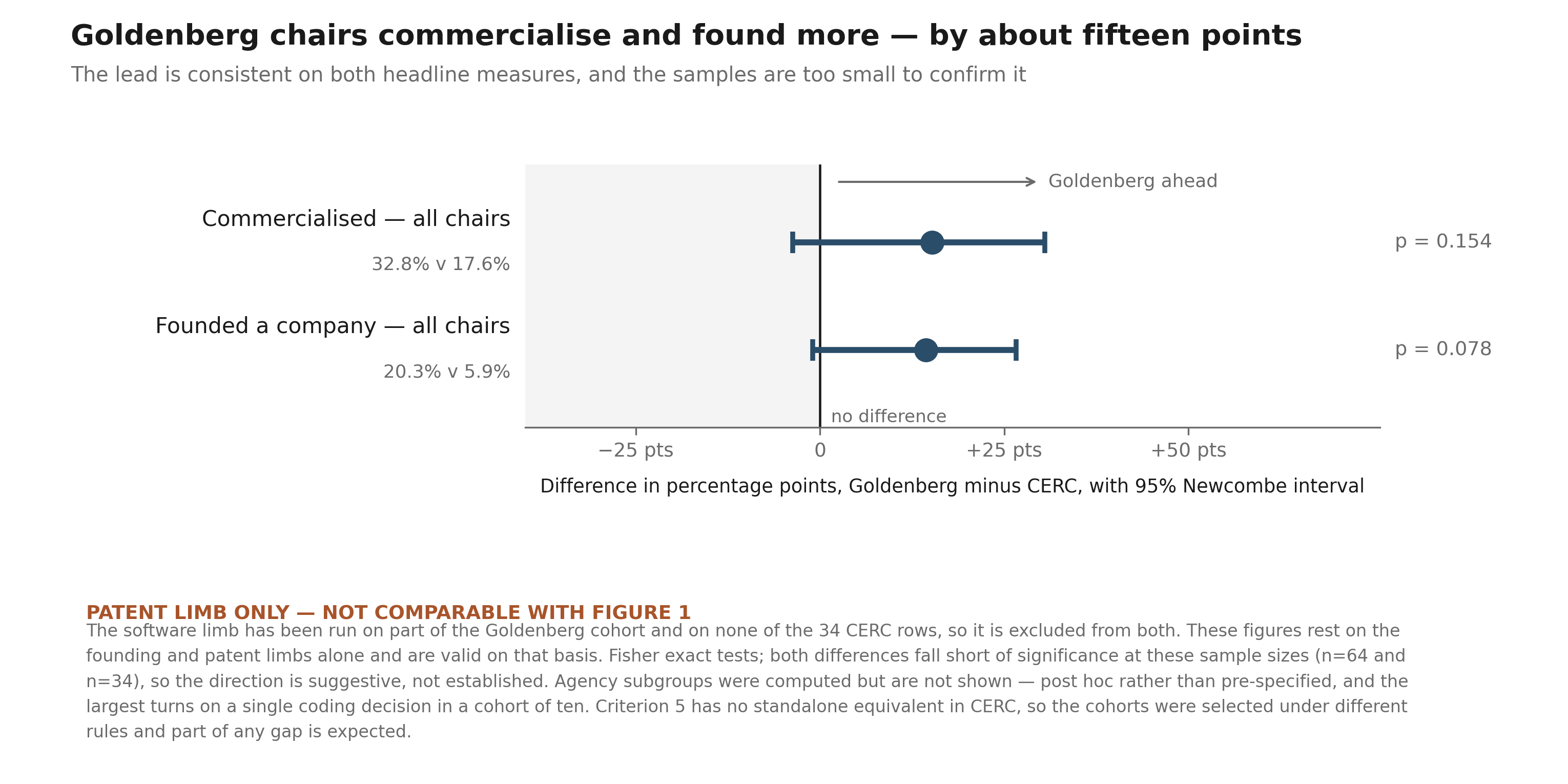
The translation criterion works. I would aim it more at commercialization.
The analysis shows that there is an important track record of commercialization in the first cohort of Goldenberg Chairs. The selection criterion related to research translation seems to have done its job. The value of past commercialization is much harder to describe than the incidence. That matters, because the real job is to shift the culture toward commercialization — and the strongest culture changers are likely the serial entrepreneurs and those who have built significant companies. Increasing this subset is probably more important than increasing the raw commercialization number.
If Canada wants to aim this or future research funding mechanisms more tightly at the problem we actually have — the commercialization gap — these results suggest it could do so by elevating the weighting of commercialization in the selection criteria. The programme could use the measures I have developed here to assess commercialization, while developing better measures of the economic value of past commercialization. Indeed, the best way to validate these figures and expand on the valuations would be to check them with the researchers themselves — something the programme is best placed to do.
This analysis assumes that past commercialization predicts future commercialization. That’s a reasonable assumption especially with serial entrepreneurs. However, three-quarters of these researchers come from the US, where the commercialization ecosystem is more robust. Also, nothing would prevent these researchers from founding their companies in the US. And Canada has a well documented problem of Canadian-founded companies re-domiciling in the US as they grow. While the latter problem is not specific to the programme, it could be tackled, as I suggested in a Globe and Mail editorial when the programme was announced, by requiring that the government’s grant funding be converted into an equity share should the company be founded or moved outside of Canada.
One objection to the direction I propose is that scientific excellence is the only thing that matters — and it will also drive commercialization. This resonates with me, and I am a huge fan of discovery science. But as a practical matter the programme already accepts translation as one of its five selection criteria and commercialization as an element of that. Any change would need to safeguard scientific excellence. My proposal is not one of principle but of balance.
Nothing here is meant to diminish the inherent value of social impact. I am a social impact researcher myself. Moreover, social and economic impact are not always so easily distinguished. Some researchers chose to share their research open source, and I could not estimate the indirect economic benefit of that. Others might have research results with important fiscal impacts — savings to the public purse — even though they don’t stimulate economic growth.
Finally, the question of how to close the science commercialization gap is a portfolio-wide one for any country. I have argued that a Canadian ARPA-H would be a good way to close it. This analysis is only a window on that question.
I met Eddie Goldenberg only once, two decades ago, when he was Canada’s top public servant. I had written an op-ed arguing that Canada should leverage the diaspora of low- and middle-income countries to support their development. At the end of the meeting, standing in the hallway outside his conference room at the Privy Council Office, I thanked him for inviting me to discuss my ideas. He said, “that’s what you get for writing a great op-ed.”
Today, the Eddie Goldenberg Research Chairs of Canada are leveraging Canada’s diaspora and international scientists to support Canada’s economic development. They will help.
Let’s aim our funding programmes more squarely at the challenge we actually have — turning science into economic value.
Disclosure: I wrote this blog myself. I used AI (Claude, Anthropic) to do the analysis, and for research and editorial assistance.
The attached annex sets out the method and the xls file contains the data. Codings reflect public sources as of August 2026 and are best-effort judgements, not statements about anyone’s full record. Corrections welcome — I’ll update the file.

Interestingly, Canadian universities are climbing up the global ranks of those whose alumni raise capital and found companies. University of Waterloo is 7th (as ranked by Pitchbook.) Unfortunately, the general business environment is not conducive to growing companies from scratch. And our proximity to the USA is both a blessing and a curse. It makes it too easy to move companies there and makes us lazy about truly innovating beyond American models of "how it's done."
Great read - as it happens I saw this on X yesterday that speaks to exactly this problem:
https://x.com/realLiamGill/status/2071548283575501298?s=20