

Would you open a savings account at the bank and never cash in the interest? Welcome to health finance.
Meet Marc, 54, who has driven the same delivery route out of Laval for twenty years. A decade ago, rising blood pressure and blood sugar were quietly steering him toward disability leave. His medications cost the public plan a few hundred dollars a year. He is still on the road, still earning, still paying tax — which returns many times what the pills cost. The government books the pills as spending. What they provide in returns like tax, it books nowhere.
Canada will spend $10 trillion on health over the next twenty-five years. We treat all of it as cost. But $1.5 trillion of it could return to government — through workforce productivity, foregone health-care costs, health taxes, epidemic avoidance, and service delivery efficiencies. Only two-thirds of it will be captured on our current path. The remaining $518 billion is left on the table — about $255 billion of it cash to the treasury, the rest reinvested in the system as care governments would otherwise have to buy.
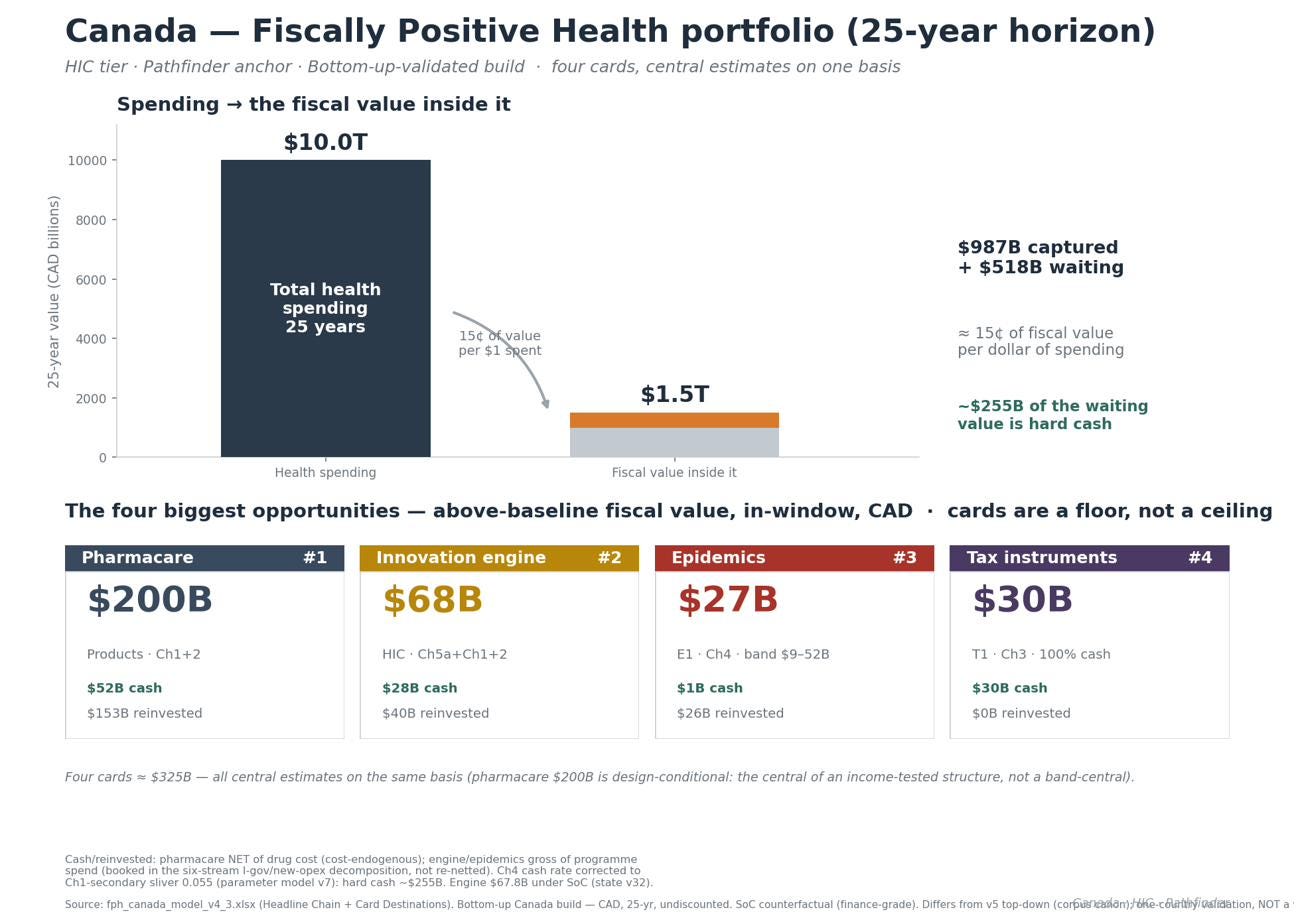
These numbers are significant at a time when Canada’s economic sovereignty is under threat from US tariffs. They are of the same order of magnitude as projected 3x returns on the Major Projects Office’s $135-billion infrastructure portfolio — the Carney government’s key response to the US threat — except those returns flow to business while the health returns flow directly to government.
The health returns are hiding on the public books because Ottawa scores infrastructure as investment, and health as expense. Fixing this is what brings the returns out of hiding. And while this piece is about Canada, the same logic applies to every country.
This may sound like a boring policy prescription, but it has real benefits for Canadians. Beds freed and queues that move, so the emergency room isn’t where you spend a night and your hip surgery happens sooner. Brain capital through dementia prevention clinics and youth mental health programmes. A pharmacare programme that scores as an investment so it survives budget cycles, meaning access to affordable medicines. New cures — and more of them made in Canada — because a system that scores return on innovation is a system that buys it. And a healthier population — because the fiscal lens shifts the question from what care costs this quarter to what it returns over years.
I wanted to figure out how to capture the returns. Using a model I developed called Fiscally Positive Health (FPH), I identified four actionable opportunities: pharmacare, an innovation engine, epidemic preparedness, and health taxes. Together, they make up about two-thirds (~$325 billion) of the amount that would otherwise not be captured.
Pharmacare as an investment
Extending pharmacare coverage from diabetes medicines and contraceptives to other drugs returns about $198 billion over twenty-five years, net of the $160 billion it costs to run the programme. The value comes from labour productivity and avoided health costs. Of that, about $52 billion comes back as cash to the treasury; the rest stays in the system as reinvestment for care the government would otherwise have to buy.
The money-losers — the high-cost biologics that don’t pay their way — are already publicly funded, through catastrophic, emergency-access and cancer programmes (and that’s a good thing). The money-winners — cardiovascular medicines, inhalers, antidepressants — have no such backstop. So for a Canadian without health coverage, we fund the drugs that lose money and leave uncovered the ones that pay for themselves. Those are the drugs a pharmacare programme would take on.
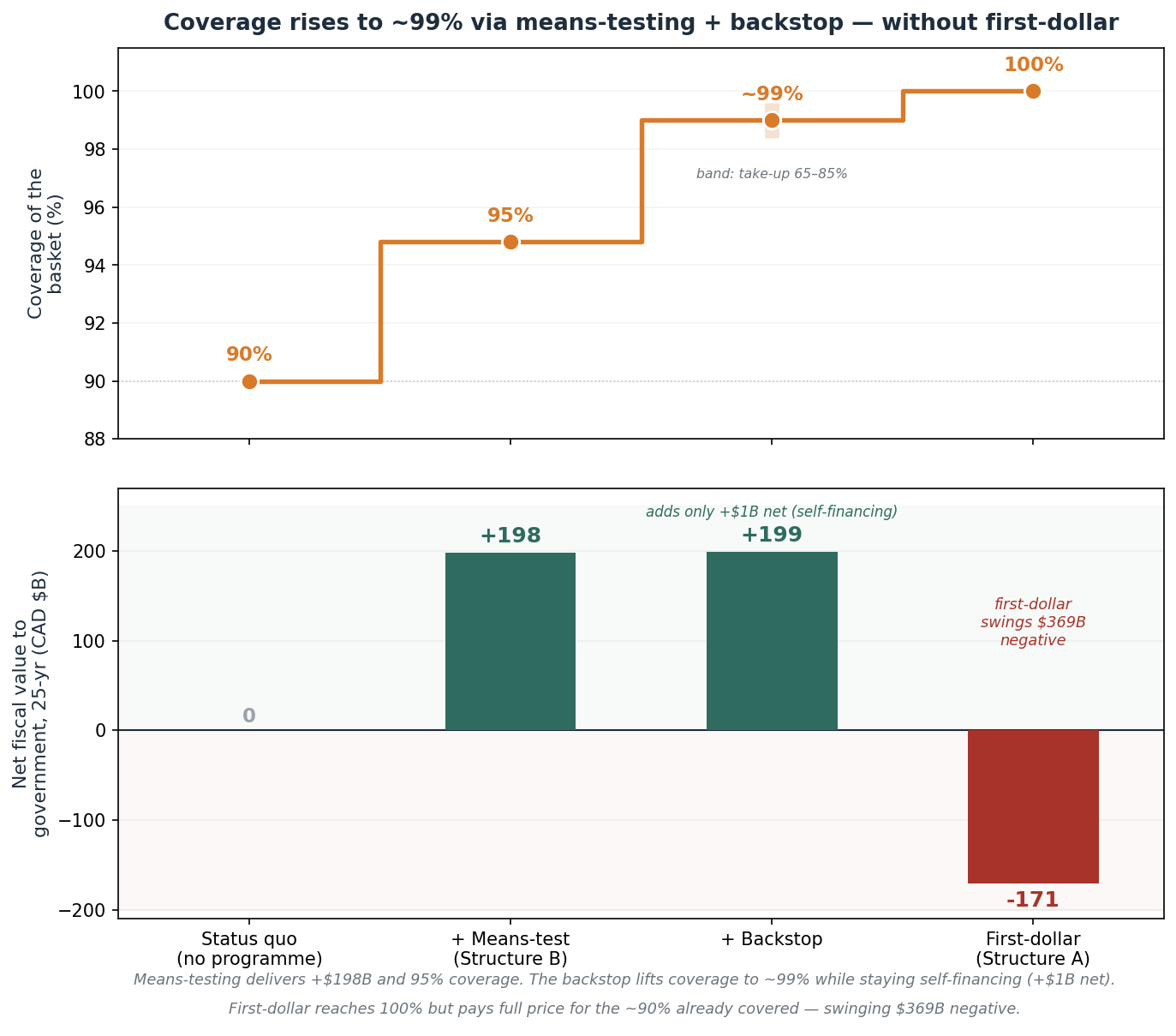
Today about 90% of Canadians have drug coverage through provincial, employer, or private plans — nearly all are eligible for a plan, though roughly one in five report coverage too thin to rely on once deductibles and caps are counted. A means-tested programme covering the fiscally positive and neutral baskets takes that to 95% at a 25-year net fiscal gain of $198 billion.
A targeted backstop, covering people above the income threshold without other insurance (often self-employed gig workers), brings coverage to 99% (the remaining 1% are eligible but don’t enrol). The backstop provides as much fiscal value (cash and in kind) as it costs, and brings people inside the programme’s negotiated prices and caps their out-of-pocket costs at a share of income.
By contrast, first-dollar coverage reaches 100% but costs $369 billion more compared to the means-tested plan. And that gap holds even with one in five Canadians lacking coverage rather than one in ten, because the premium comes from paying for the already-covered, not from the size of the gap.
Full universal coverage over a targeted approach — the opposite of where these numbers point — was the direction recommended by the 2019 advisory report. In 2024 the Trudeau government introduced the pharmacare bill, based on the report’s principles. Reading pharmacare as a cost, the Carney government’s later budget made no provision to expand it.
The Globe and Mail called the bill a costly error, and for years its columnist André Picard had questioned why Canada would replace private plans that already cover most people rather than target the minority without coverage. They were right — and this analysis explains why in quantitative terms.
An innovation engine: worth more as one
The next tranche of that above-baseline value is a domestic health-innovation engine, worth $68 billion in cumulative 25-year fiscal value. It would run three programmes. Mission AI backs AI-enabled innovation in how care is delivered — predicting which patients will deteriorate and letting lower-cost workers do what higher-cost workers do now. Frontier products span domestic biomanufacturing, mRNA, CAR-T, CRISPR and more. Brain health is prevention aimed at early childhood, youth mental health, and dementia. About $28 billion of the $68 billion is cash to the treasury; the rest is freed clinical capacity reinvested into health care. The engine’s own public cost is about $2.5 billion over twenty-five years — and it is built to draw in two to three times that in private capital.
For fifteen years Grand Challenges Canada has used this model to back many bold ideas and scale the few that work. And the national rollout of the Vital AI and data platform could measure the fiscal footprint. Deploying its precursor across 21 Ontario hospitals avoided roughly $51 million in costs and freed 50,000 hospital bed-days over eighteen months.
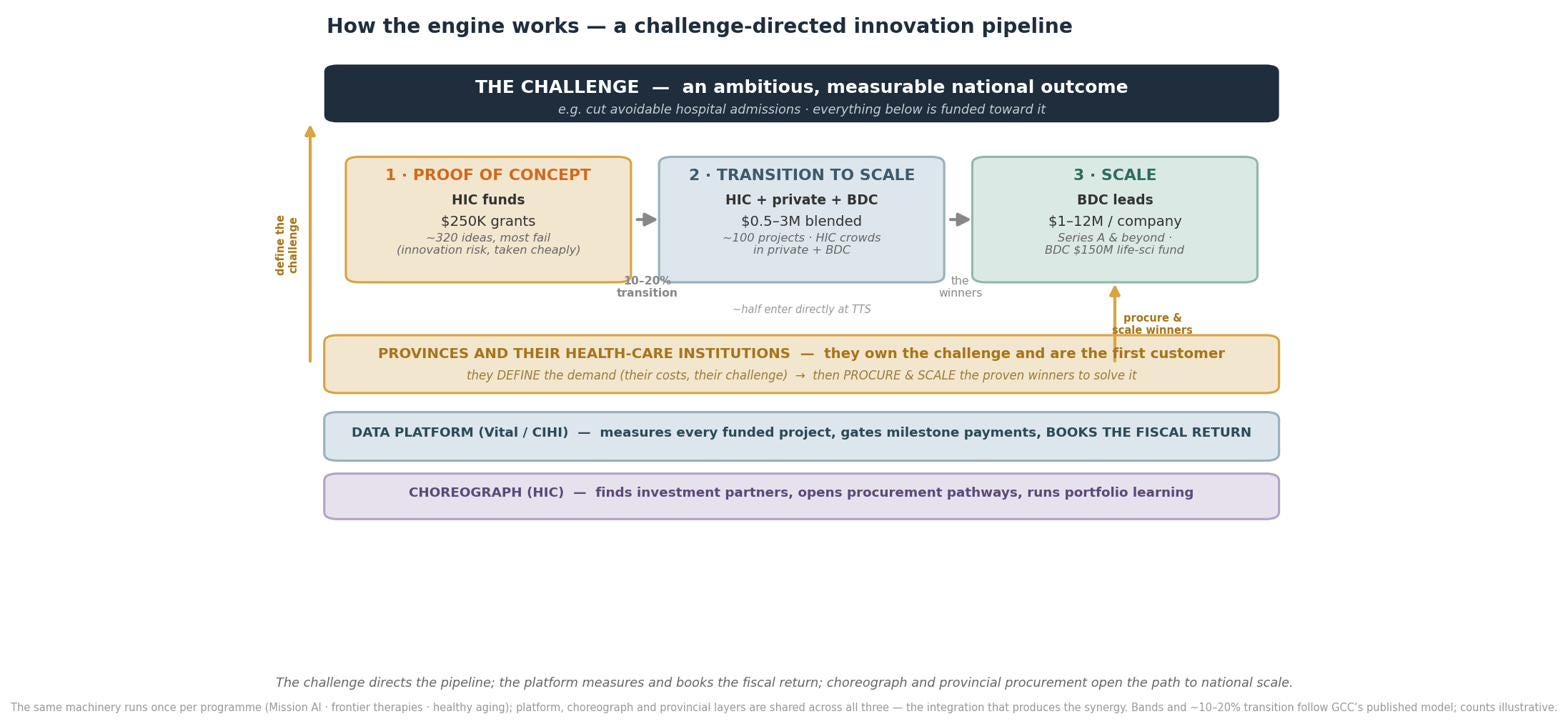
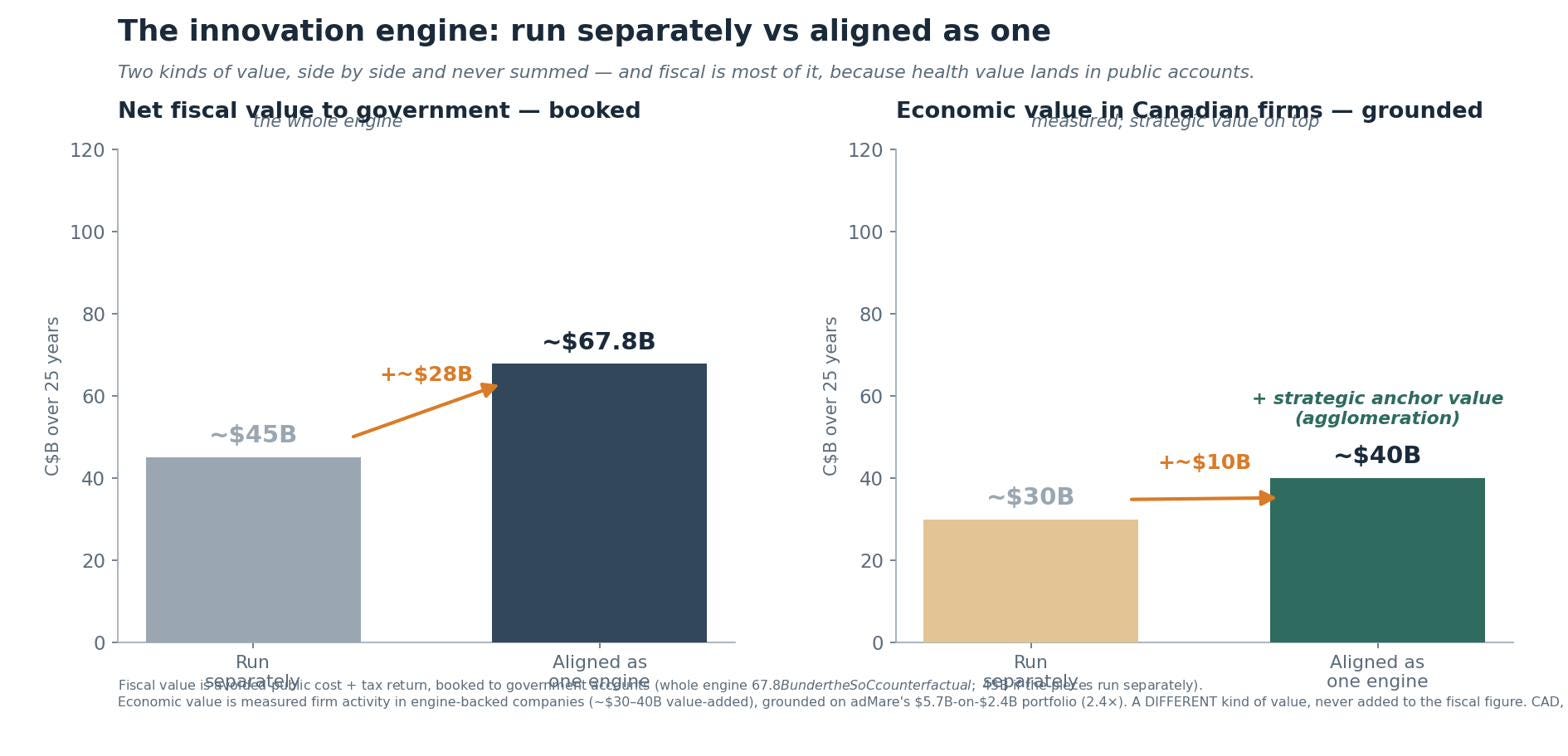
Run separately, the engine’s pieces return $45 billion; aligned through a single arm’s-length agency, $68 billion — about half again. The gain comes from the two steps the pieces cannot do alone: booking the savings and buying from the winners. Left apart, the predictable Canadian pattern follows: good ideas never reach national scale, savings nobody books, procurement that defaults to the recognized foreign name, and the promising firms bought by U.S. capital and moved south.
The economic value of the companies it would build comes on top, requires investment, and flows to businesses. It’s smaller than the fiscal value to government, but it’s important as industrial policy. Canada is the only G7 country without a home-grown life-sciences anchor company — an aligned engine improves the chances of that.
The money for the AI part has already been announced. What is missing is the decision to align the pieces and focus them on national challenges — the natural cornerstone of the Life Sciences Strategy now in development.
Preparedness pays — if you measure performance
A smaller tranche buys insurance: epidemic and AMR preparedness, worth ~$27 billion over the 25-year horizon (somewhere between $9 billion and $52 billion, because no one knows when the next pandemic arrives). The cost of readiness is modest — $5 to $15 billion over twenty-five years — against a pandemic bill of $250 to $360 billion. This is not cash but avoided loss — value from the pandemic that doesn’t occur, which is also why preparedness is hard to fund.
Another reason preparedness has been hard to fund is that we measured it wrong. Static scorecards failed their one real test: the US and Britain topped the Global Health Security Index, then had among the worst COVID outcomes. The 7-1-7 target — detect an outbreak in seven days, notify in one, respond in seven — scores how the system is actually performing; some fifty countries are adopting it, and only about half meet the early-response target. That gap is the opportunity — including for Canada, which in late 2025 lost its measles elimination status for the first time since 1998.
Canada already has the institutional home for this. Health Emergency Readiness Canada — the new readiness agency modelled on the United States’ BARDA — launched in 2024. But it still lacks a permanent head and a budget.
Health taxes are pure cash and the hardest politics
The last tranche is the only one that arrives as pure cash, and costs the treasury nothing, but it’s the hardest to implement. Health-tax reform — tobacco, alcohol, sugar-sweetened beverages, and taxes on ultra-processed food.
A new sugar-sweetened-beverage levy ($12 billion), a tobacco rate increase ($11 billion), and alcohol measures including defending the indexation already in law ($6 billion) represents ~$30 billion over 25 years.
But the politics are hard. Tobacco tax revenue is dropping as smoking rates fall; that’s a good thing. Alcohol tax indexation has been capped at 2% for a 2-year period in response to affordability concerns. Similar concerns would make a sugar-sweetened beverage tax hard, even though more than 115 other countries now have one. Push tobacco or alcohol beyond inflation and you soon hit black markets.
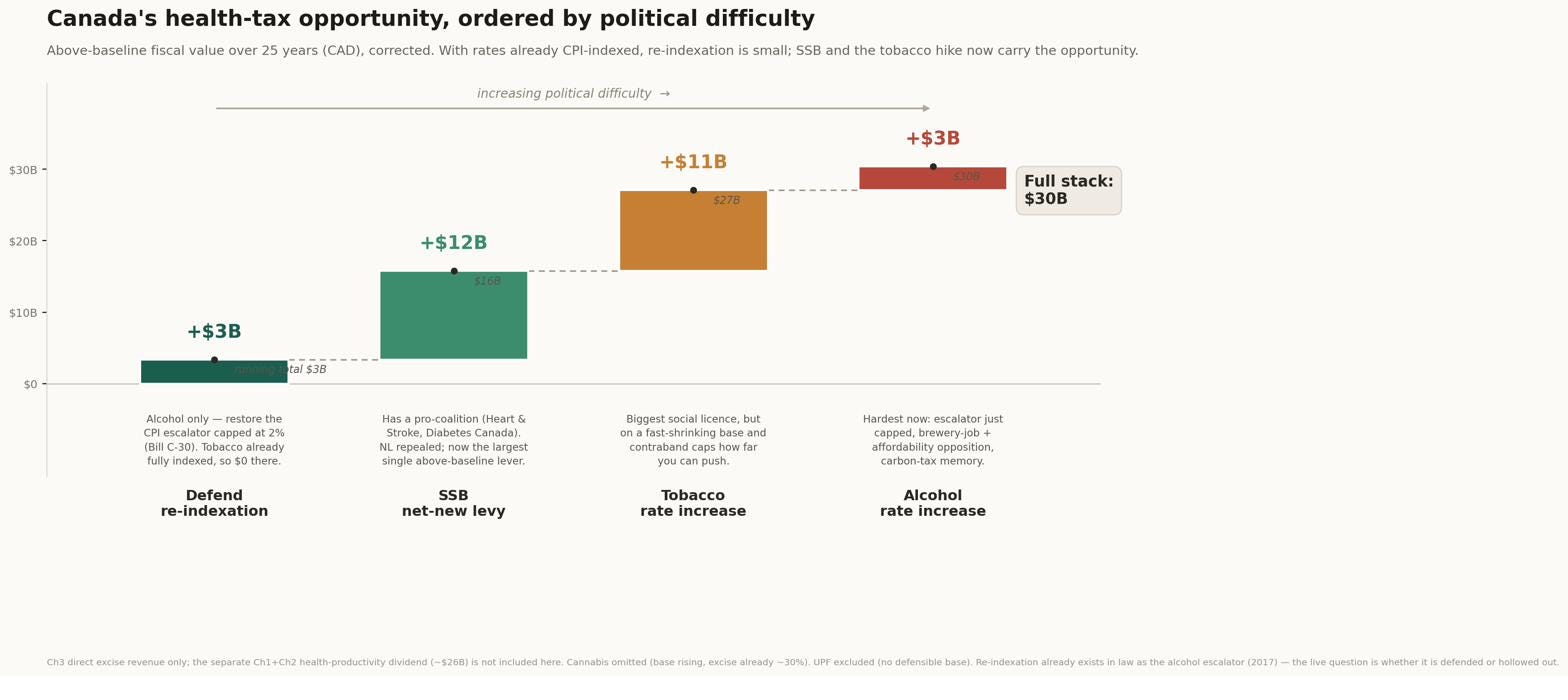
The Philippines has shown that earmarking health tax revenues to flow back into the health system makes them more politically durable. Finance departments resist earmarking — because they want the flexibility — but the Philippine lesson is that a little rigidity bought political licence the taxes could not earn alone.
The choice
Four opportunities, about $325 billion, all of it flowing to government. The instruments exist: pharmacare has a worked design, the innovation engine has fifteen years of Grand Challenges Canada behind it, and preparedness has a readiness agency already on the books, if not yet resourced.
The obvious objection is that fiscal returns from health are routinely oversold. Productivity gains do not all become tax, and a freed hospital bed in a queued system produces more care, not a smaller budget line. Both points are right, and already in the model. Less than half the return is claimed as cash; every programme’s cost is netted against the cash; and the in-kind half is claimed as what it is — care the government would otherwise have to buy, reinvested into the health system. And to the sceptic who would discount these returns to present value: fair enough — but then discount the spending too, because it is the same dollars on both sides of the ledger, and the ratio between them barely moves — though the absolute figures do shrink.
Finally, in a federation these returns do not all land on one balance sheet: the productivity-tax accrues mostly federally, the avoided health-care costs provincially — so capturing the full amount needs both orders of government to share the investment and the return.
One thing this argument does not mean: fund only what pays. Canada covers cancer drugs and rare-disease therapies because people need them, not because they return money — and it should. The argument is narrower: the part of health spending that does pay should be optimized and scored as what it is.
It also means scoring health’s fiscal returns over a multi-year horizon, the way Ottawa already scores infrastructure, defence procurement and pensions. No government yet books this, and the Auditor General would doubt 25-year returns on a social programme. But with Vital, for the first time, we can measure it. Even if government cannot yet borrow against the returns, the numbers are an argument a finance minister can appreciate.
Canada is the worked example, but I modelled the same FPH framework in 58 countries. The top-down numbers exist for all fifty-eight; what makes a number a finance minister can use is the bottom-up build. If your country wants one, write to me.
Canada will spend the $10 trillion whether or not it captures any of it. Ottawa is capitalizing its pipelines while expensing the largest return-bearing asset on the public books. No one is better placed to see it than a central banker turned prime minister. I would book it.
Disclosures: I am a co-founder, former CEO and current board member of Grand Challenges Canada, which informs the model recommended here for the innovation engine. I used AI (Claude, Anthropic) for research, modelling, drafting and editing; but the judgments, conclusions and recommendations are mine, and I rewrote the text so it is in my own words.
Here is the technical paper with more details and the model itself.

Your consolidated $518B rests on a federal-provincial split you name in one line but don't resolve. Provinces fund most of the delivery and would carry the bulk of a pharmacare expansion, yet the productivity-tax return you're counting accrues mostly to Ottawa. That's a landlord buying a more efficient furnace to lower the tenant's electricity bill. The party writing the cheque isn't the one who banks the biggest return, so each level, reading only its own ledger, sees a worse deal than the national math shows and has an incentive to wait for the other to move first.
So my question: what actually forces the split to get shared? The avoided-cost saving lands provincially whether or not Ottawa pays, and the tax lands federally whether or not the provinces pay, which looks like a free-rider standoff on top of an already contentious health-transfer file. Is there a mechanism in the model that closes that gap, or does capturing the $518B quietly assume a level of federal-provincial cost-and-return sharing that Canadian fiscal politics has rarely delivered?