
Is The Lancet antisemitic?
No — but it stokes hostility to Jews

Since the Hamas terrorist attacks on October 7, 2023, The Lancet has been involved in a series of controversies about its coverage of the conflict. On social media it has been accused of anti-Semitism. Honest Reporting is more careful but clear: “For years, @TheLancet has published misinformation in order to demonize the Jewish state.”
I’ve known its editor, Richard Horton, since the 1990s, and liked him for his contrarian approach. Before October 7, he told me, and has written publicly, about how he changed his mind on Israel after being invited to visit in the wake of an editorial controversy about nondisclosure of conflict of interest of authors in 2014.
I have published a dozen pieces in The Lancet over twenty-five years — on live donor lung transplants, end of life care, polio, global health, and even editorial independence of medical journals.
I wanted to dig in deeper and more systematically to understand what was going on.
I compiled the journal’s coverage of the conflict from PubMed, counting items by type and comparing the volume against other contemporary wars; I read its editorials and the editor’s “Offline” columns since October 7 and coded them against a fixed rubric; and I reviewed some of the controversial letters and replies, and news items, and traced how some of these travelled beyond the journal’s pages.
What I found was three mechanisms, which I first describe and then compare to normative standards and trace their implications.
Selective coverage. In the period since October 7, 2023, The Lancet published roughly five times as many items on the Middle East conflict as on the war in Sudan — about a hundred to Sudan’s twenty — and more than on all six other conflicts (Sudan, the Democratic Republic of the Congo, Syria, Ukraine, Yemen, and Myanmar) combined. The disproportion is not explained by scale of suffering: Sudan’s war has produced famine and the largest displacement crisis in the world. Most of this attention is carried not in peer-reviewed research but in correspondence.
Flashpoint letters and news items. In July 2024, a letter projected that up to 186,000 deaths might ultimately be attributed to the war — a non peer-reviewed estimate built on a contested historical multiplier. I was one of the scholars who critiqued that estimate. One of the replies — by the Vice President for the Board of Deputies of British Jews — quoted my assessment: “there is no new data here. Its methods: take one unreliable number and multiply by another unreliable number to get a bigger unreliable number.”
Within days of publication, Charlie Angus — then a sitting Member of Canada’s Parliament — posted the figure to his followers. “186,000 innocent people murdered in Gaza by Israel,” he wrote. “This is a staggering number put together by The Lancet. It is genocide.” The letter’s “it is not implausible to estimate that up to 186,000… deaths could be attributable” had become, in twenty-four hours and under the journal’s name, a flat count of the ‘murdered’ and a charge of genocide from a Parliamentarian.
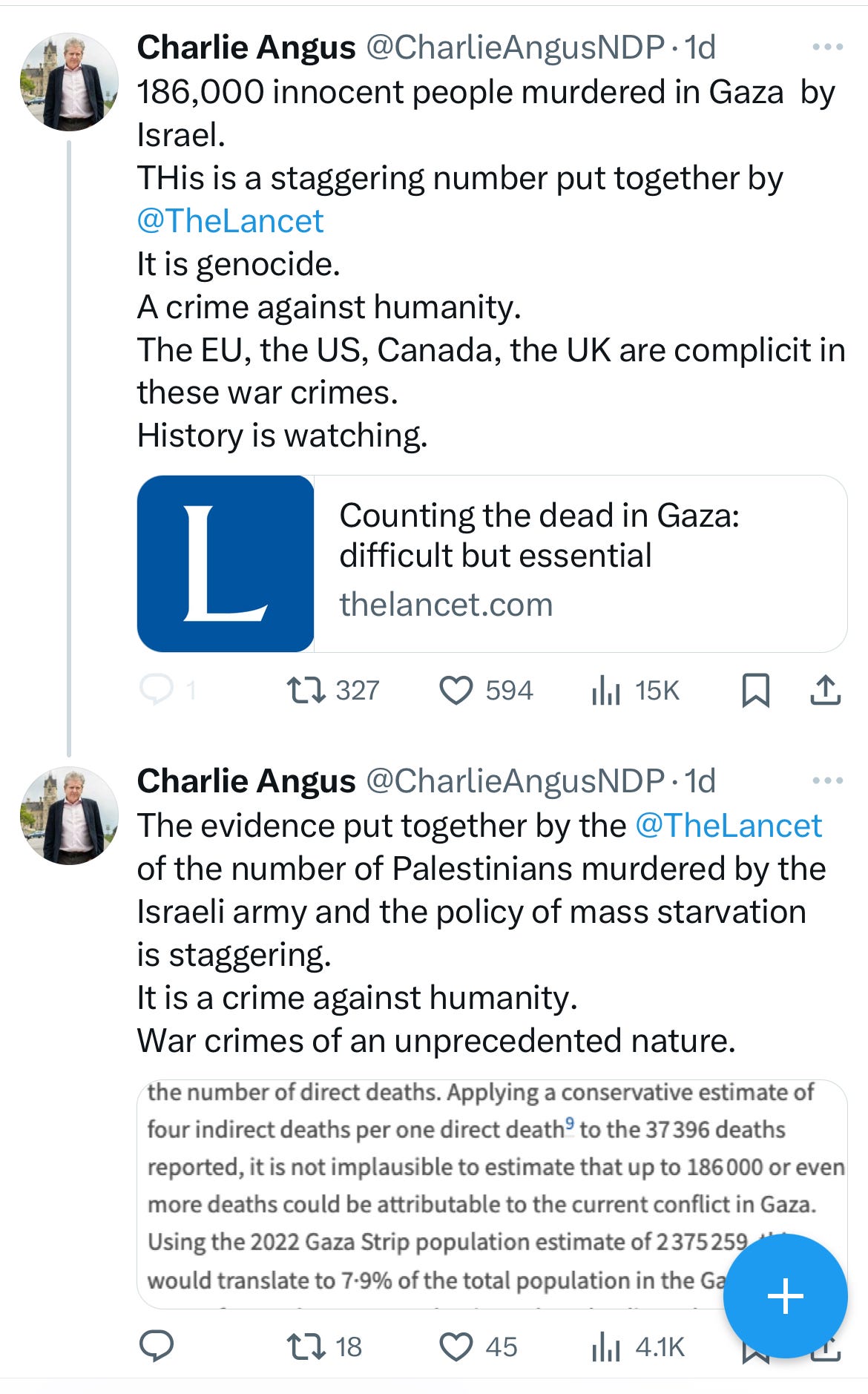
UK MP Zarah Sultana told her followers the journal “conservatively estimates that the death toll in Gaza could be 186,000 or more.” Before a House of Commons committee in November 2024, a surgeon who had worked in Gaza cited the same letter as “conservatively 186,000 dead,” adding that to his mind it was “over 200,000 now.” One of the letter’s own authors, Martin McKee, later said the work had been “greatly misquoted and misinterpreted.” The American Jewish Committee (which also quoted my critique) warned that headlines falsely implying the journal had endorsed the figure would have “repercussions for Jews around the world.”
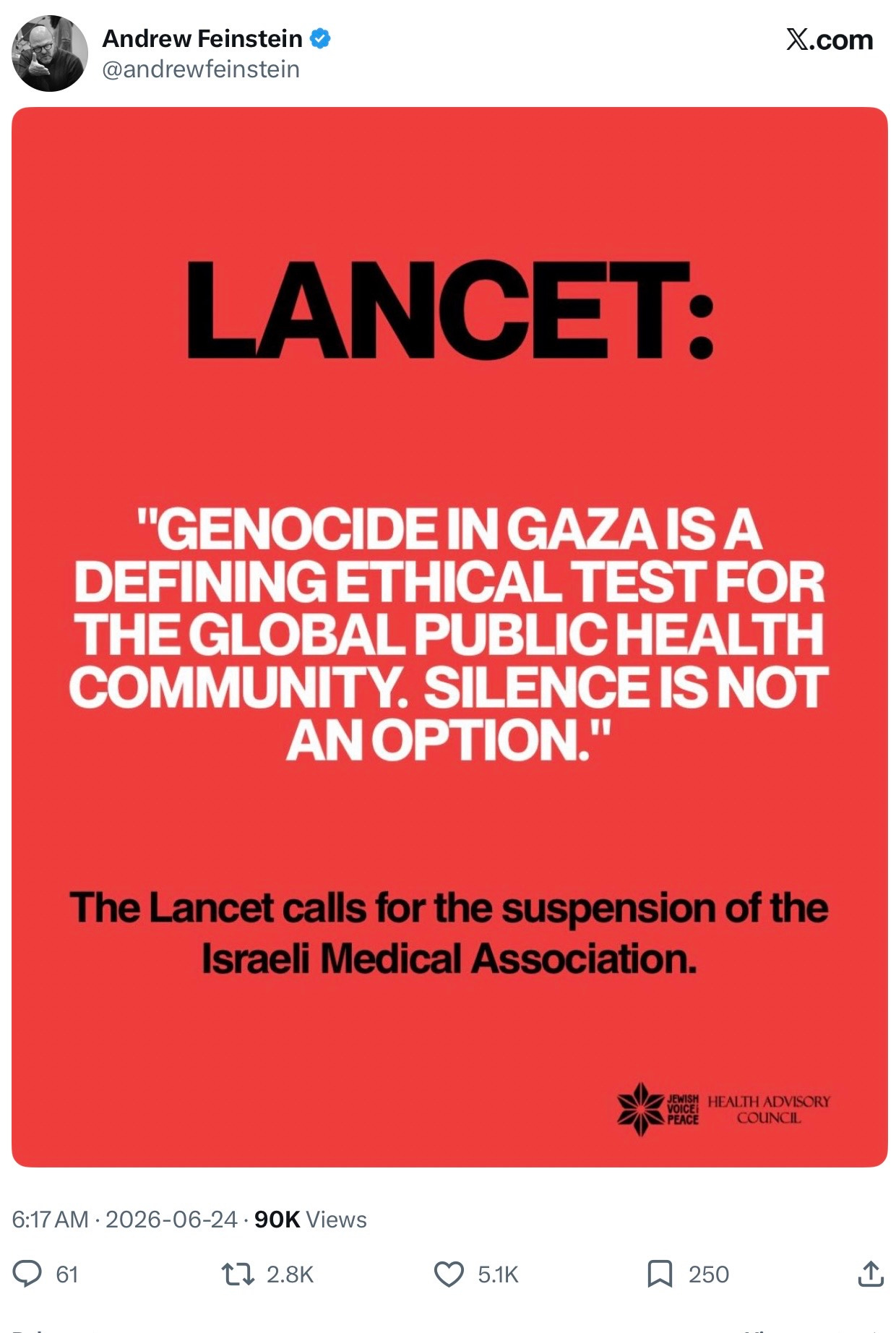
A 2025 letter entitled “Break the selective silence on the genocide in Gaza” asserted genocide as established fact, stating: “The genocide in Gaza is a defining ethical test for the global public health community, social scientists, and academic associations.” Another letter coined the term “healthocide.” The journal usually carried rebuttals, but long after the controversy had been framed. And in the “healthocide” case both published replies were in agreement.
In June 2026, a World Report news feature — “Petition calls for boycott of Israeli Medical Association” — led with a campaign to suspend the Israeli Medical Association from the World Medical Association. The accusers were quoted first (the IMA had “colluded in the unspeakable treatment of Palestinians”) and last (the IMA had “broken every WMA rule in the book”). The piece did carry the IMA’s reply, that the allegations were “at worst, lies, and at best, highly contested allegations presented as fact,” and the WMA’s, that it “stands against exclusion of any of its members for the actions of their governments.” But the headline, the standfirst, and the order of quotation gave the campaign the prominence of the journal’s news pages.
Within days, a widely shared graphic — tens of thousands of views — stamped “LANCET” above the words “Genocide in Gaza is a defining ethical test… Silence is not an option,” and declared: “The Lancet calls for the suspension of the Israeli Medical Association.” Neither was the journal’s. The words were from a letter by four authors; the call came from a petition the journal had reported. But both had become framed as in the journal’s own voice.
By contrast, I could find no coverage of the suspension, now reversed, of the Federation of Israeli Medical Students from their international federation. Ironically, the Israeli medical students had submitted a correspondence in response to an article entitled “Israel-Palestine: dehumanisation and silencing.” Their letter, entitled “‘We too are humans’: A message from Israeli medical students,” was rejected. (By way of disclosure, I also sent a piece on this to The Lancet which was rejected.)
An increasingly one-sided editorial voice. I tracked how the journal handled the word “genocide.” In December 2023 the editor called it “contentious and the subject of fierce disagreement,” attributing it to a Gazan doctor rather than asserting it himself. Through 2024 it appeared only inside quoted court filings and the words of officials.
By September 2025, Horton no longer attributed the word to others; he made the claim in his own voice. Reviewing the famine declaration, he asked: “Who can deny now that this systematic obliteration of a people is not genocide?” Those who argued the toll was “nowhere near enough to constitute genocide” were offering, he wrote, “slippery rationalisations” that made “one’s stomach turn.”
The same one-directionality governs how the journal reports attacks on hospitals. In the journal’s editorial, Israel is named as the perpetrator. Here and in the editor’s columns, the contention that Hamas militarized medical facilities (the argument that complicates every such account and under certain conditions removes a facility’s protection under international law) does not appear. The claim surfaces in correspondence, where letter-writers both advance and dispute it, and in a news feature — but there only as the Israeli government’s claim, immediately set against a scholar who calls it “making excuses” and “using an entire legal apparatus to try to show it’s lamentable but necessary in Gaza.”
How do these mechanisms compare to normative standards?
Is this antisemitism? No. I reviewed the widely used IHRA working definition of antisemitism and found that none of these mechanisms reaches the standards for antisemitism set out there. The definition turns on double standards demanded of “any other democratic nation,” on the symbols of classical Jew-hatred, on holding Jews responsible for a state’s conduct. The coverage does none of these. It does not deny Israel’s right to exist or traffic in the old tropes. Horton condemned Hamas as “terror, pure and simple.” The journal stood up a Commission on medicine, Nazism and the Holocaust.
What most enables modern-day Jew hatred, however, is not antisemitism but antizionism. There are a range of definitions, but for me the most compelling, developed by Adam Louis-Klein, argues that antizionism works through a repertoire of libels — among them genocide. It is not simply criticism of the Israeli government’s actions. It relies on historical and intellectual traditions such as Soviet antizionism and Western settler-colonial theory.
The latter perspective underlies Horton’s view of global health. In 2018 he wrote admiringly of one of that canon’s key figures, Frantz Fanon: “Global health is about power and poverty, violence and exploitation, oppression and silence, and collusion and exclusion. If one views global health using this broader lens, the historical turn that was the decisive and creative moment for the birth of global health was surely decolonisation. … And the person who wrote the first manifestos for global health was Frantz Fanon.” Although Horton’s piece predates October 7 and he wasn’t linking Fanon to the Middle East conflict, others in the pages of The Lancet have. I would like to know whether Horton thinks it applies.
By Klein’s account, which I have come to share, The Lancet’s drift in editorial stance, and the letters it platforms on genocide, amount to antizionism. And whether or not one accepts that label, the consequence is the same: claims that travel under the journal’s authority, shed their qualifications, and land on Jews.
All of this lives in a climate where hostility to Jews has risen sharply since October 7, 2023 — including within medicine itself, where Jewish physicians across Canada, the UK, Australia, and the United States report antisemitism increasingly “couched in the more ‘acceptable’ clothes of anti-Zionism.”
I don’t argue that medical journals cannot take a position. My objection is about how The Lancet does so — selective coverage, flashpoint letters and news items where one side is reactive, and one-sided editorials — and how that is interpreted once the claims leave the journal’s pages.
A medical journal carries the brand of science — rigour, objectivity, truth. But this brand is built by original research. The core problem here is the imprimatur of objectivity stamped on coverage — mostly in correspondence and editorial — that is not. It’s a veneer of objectivity: advocacy dressed as science. That is what makes the claims travel, amplifying their consequences. By cloaking antizionism in scientific authority, the journal stokes hostility to Jews.
Richard Horton could reply that the journal is not responsible for how others interpret its content. But I think it is responsible to mitigate harms to an identifiable group, Jews, that the journal can reasonably foresee.
A century ago, in “Politics as a Vocation,” Max Weber distinguished an ethic of conviction — which acts on the rightness of its cause and leaves the consequences to others — from an ethic of responsibility, which answers for the foreseeable consequences of its actions. What is wrong here is not conviction, but conviction without responsibility. A journal that claims the imprimatur of science owes responsibility.
I would argue that the difference between a scholar and a revolutionary — or an editor and a pamphleteer—is a sense of responsibility for the consequences of the words you publish. To me, that responsibility is exactly the issue — and it raises the question of what the journal should do.
The journal could proactively invite contrary views in its comment and viewpoint sections. It could be more careful with correspondence, as in the case of the Israeli medical students, to ensure those who are excluded from professional opportunities are not also excluded from The Lancet’s pages. It could be more careful not to turn news into quasi-editorial, as it did in its piece on the Israeli Medical Association. And it could correct misinterpretations of what is published. When a parliamentarian says the 186,000 number was “put together by The Lancet,” or an activist says, “The Lancet is calling for the suspension of the Israeli Medical Association,” The Lancet could correct them.
None of this requires the journal to change its editorial position — although I might wish it would. It asks the journal to be as careful with its authority as it is expansive with its convictions.
What it does require is for The Lancet to acknowledge the problem and seek solutions.
Disclosures: I write on this subject and I am not a neutral party to it. I criticized the 186,000 mortality letter publicly when it appeared; my comment was subsequently quoted in The Lancet’s correspondence pages by the Board of Deputies of British Jews, and elsewhere by the American Jewish Committee. I signed an open letter in defence of medical neutrality at the World Medical Association, and I was involved in the parallel matter of the Israeli medical students’ federation’s suspension from the International Federation of Medical Students’ Associations. I have also written on Substack about selective attention to attacks on health facilities — one of the patterns this piece examines. I have known and liked Richard Horton, the editor of The Lancet, since the 1990s. Readers should weigh all of this. I used AI (Claude from Anthropic) to assist with research, coding, drafting, and editing. But the arguments, judgments, and conclusions are mine and I wrote the piece myself.
Peter, your unwavering commitment to global health, truth, and justice is one of the reasons your voice continues to matter so much.
In an age of polarization, God is in the details. Scientific journals derive their authority from precision, balance, and intellectual discipline. When those virtues give way to advocacy (even for a cause one considers just) they risk eroding the very trust on which their authority rests.
Your invocation of Weber is particularly apt. I would add another voice: Spinoza's single word, Caute ("be cautious"). It is not a call for timidity but for intellectual responsibility. Words published under the imprimatur of science do not merely describe reality; they shape it. Their foreseeable consequences therefore become part of their ethical meaning.
Conviction without responsibility is not enough, especially for institutions whose credibility rests on the pursuit of truth.
A remarkable and trenchant analysis of the transformation of antisemitism to
pc anti-zionism. We need a public health approach to the prevention of it and genocide.
We cannot rely on, or expect, objectivity from the medical establishment, the UN or world opinion…